Showing posts with label Veneer. Show all posts

Sunday, January 7, 2018

Ogee Clocks - Veneer Combinations and Variations

I find it quite common for people to have difficulty identifying various wood species on clocks. I will frequently see collectors confusing mahogany, rosewood, and walnut, as well as other species. While it can often be difficult to identify a particular wood species with just a photo, or under thick and darkened finishes, I wanted to try to illustrate some decent examples of the most frequently found types as well as feature some rare and unusual combinations, or examples with special "cuts" of wood.

Disclaimer: this blog post is meant to illustrate various veneers used on ogee clocks, and as such, it is not intended to be used as an in-depth guide on how to identify specific veneer species. Wood identification takes many years of practice and experience to master, and it's not a topic I can cover in a single blog post, and with only a handful of images. It is my sincere hope that it will still be very useful and informative.

For those of you know know me rather well, you will not be surprised to hear that I adore ogee clocks. I know they are not to everyone's taste, but for me they have a lot of positive features, and few negatives. At the time of this writing I own over a dozen of these clocks, from small miniatures to very large 8 day models. I plan to highlight the rather wide ranging variety of ogee clocks in my next post, but for now, let us focus on wood.

If you are familiar with ogee clocks you will already know that the word "ogee" refers to an "S" shaped curve, which forms the basic moulding on the front of the clock case. The term "O.O.G" may sometimes be found, and this term usually refers to the thin banding that forms the door frame and the outer edge of the case being in concave and convex profiles. The standard ogee cases simply have flat stock on these case pieces.

Typically, all American made ogee cases were built from a pine or poplar secondary wood, and veneered in beautifully selected woods. The most popular two choices being mahogany and rosewood. Both of these woods were popular from the 1840s, right up to the 1910s when the production of ogee clocks started to decline. The veneers on the fronts of the cases were often extremely elaborate and well chosen, while the veneer on the sides of the cases were usually quite plain and rather poorly figured. It is not uncommon to find a non-matching wood species veneered on the case sides. I have seen several examples where birch veneer was used on the sides, giving the sides a rather light orange colour compared with a much darker mahogany (or rosewood) on the front.

It is also important to note that not all ogee clocks had veneer. In very rare cases, some were grain-painted to resemble mahogany or rosewood (I have no examples to share but I have seen a few). It is also fairly common to come across "skinned" ogee cases, where the original veneers have chipped off and been completely removed. These are often refinished with the underlying pine stained dark and varnished. In my opinion, these clocks have lost one of their most important features, and should be considered as parts donors, unless the time and expense to re-veneer the case is deemed appropriate, or the owner appreciates the clock "as-is".

Note: Images in this post are collected from various sources. These are not clocks that I own.

COMMON VENEERS

Let's start with a fairly simple example.

MAHOGANY:


The clock shown above is a beautiful H. Welton and Co. ogee clock with spectacular mahogany veneer, dating from the early 1840s. The veneer on the banding (door and trim) is plain mahogany while the ogee curves feature crotch mahogany veneers. The crotch figure comes from the joint where the trunk separates into two branches, forming an arch, and often also a flamed figure. Because the wood grain has so much of a pattern, the seams between the sheets of veneer are often visible. Two joints are easy to spot in the top ogee moulding.

Not all mahogany ogees have crotch mahogany. Many of them have very plain veneers or "ribbon stripe" mahogany, but others have very ornate "fancy cut" veneers such as this Seth Thomas. The veneer is just plain mahogany (as far as I can tell), but it has been cut in a certain way to give a repeating spiral or swirl pattern. This veneer treatment can be found on many other clocks including large column clocks and small shelf clocks. For lack of a better name, I have started to refer to this as "S curve" veneer.


The clock above is a Plymouth Hollow era Seth Thomas (prior to 1865), with the painted tablet missing, but I have seen this veneer cut on clocks as late as 1880. The effect is very similar to crotch mahogany, because of the change in the direction of the grain, but there are no seams in the veneer (or very few), so you get a very nice continuous squiggle.

ROSEWOOD / MAHOGANY:

Adding to the confusion in the identification of wood species is the fact that many manufacturers liked to "mix and match". Since rosewood and mahogany are so similar, they are often used in combination, such as on this ogee clock. On this example, the obvious "stripe" effect on the rosewood banding (and door) are clearly visible, while the ogee mouldings have that same "S curve" veneer in mahogany, but with a less aggressive repeat to it.


The ogee clock shown above is an E.N. Welch from the 1860s (also with the tablet missing). The dial is a little worn, but has lovely hand painted floral corners. Many clocks had partial elements in rosewood and mahogany, so it's something to keep an eye on. If you want to see another example of this, have a look at the Seth Thomas column clock (scroll all the way down to the last two photos in the link below). The case is 90% mahogany, with crotch mahogany on the two ogee mouldings, but the door is rosewood. https://jcclocks.blogspot.ca/2014/01/very-rare-seth-thomas-8-day-column_26.html

ROSEWOOD:

Rosewood is one of the trickier woods to identify because it often looks different from clock to clock. It can range from almost uniformly deep red, to black and red stripes, to wild brown and blonde. One characteristic to look out for when trying to identify rosewood is that it is much harder than mahogany, and more brittle. It is a slightly oily tropical wood, and as such it is also much more prone to flaking, lifting, and chipping. The wood itself is also fairly coarse a lot of times, and it can even resemble oak (as far as the grain texture). Because the wood is harder to work with, it also tends to have been cut into thinner veneer to facilitate bending and gluing. Rosewood also tends to be a fairly narrow tree, so there is often a lot of repeating lines in the veneers (usually less than 6 inches before a repeat).

Here's a typical rosewood ogee:


This ogee is by Terhune & Edwards, around 1860-70. Note the deep blackish striped areas, as well as the lighter spots leaning ever so slightly to a softer tan colour. Many rosewood clocks tend to be much darker as well, some are nearly black all over.

Here's a much more dramatic rosewood veneer showing the very wide range of colours and striping that can be found in rosewood. The banding on the door and edge are also rosewood, but in a uniform colour. Note that this particular rosewood shows almost no red.


The clock above is a miniature spring-driven clock by E.N. Welch. Approximately 1860.

Here is another rosewood example with a much more subdued grain somewhat resembling oak. You can clearly see the black striping effect often found in rosewood.


This clock is by JC Brown, of Forestville CT. Approximately mid-1860s. I have a Seth Thomas in nearly identical rosewood veneer.

UNCOMMON VENEERS

OAK:

Oak veneer is very rarely found, and the examples I've seen tend to be made by Seth Thomas and for sale in Canada. I'm fairly sure some may also have been sold in the United States, but many of the oak examples have Canadian labels. One exception that I came across is a two-tone example of an 8 day Forestville ogee clock which seems to have white oak crotch veneers on the ogee mouldings, and rosewood banding (no photos, but it is a clock I own and I will photograph it and share it once it's restored).


The ogee shown here is by Seth Thomas, and it is veneered in what I believe to be white oak. I don't have the label information for this piece, but it appears to be from around the 1860s. The Upper Canada Village in Morrisburg Ontario have in their collection a Seth Thomas column clock in oak veneer with a Vantassel label (Canada).

BIRD'S EYE MAPLE:

Bird's eye and curly maple are found fairly frequently on clocks before 1860, but very rarely afterwards. For whatever reason, bird's eye maple seems to always be combined with a darker wood (as opposed to being used on its own for a whole case).


Technically this is called a "bevel case" since it lacks the ogee curve, but for our purposes I have chosen to include it because the case style is nearly identical. On this lovely Sperry clock from the 1840s, you can see beautiful bird's eye maple, combined with mahogany on the banding and door. This clock would likely have had a lovely hand painted scenery with trees and a stream in the tablet.

Here is another example:


This clock is also bird's eye maple with mahogany banding, and it's by the Union Manufacturing Co. It dates from the early 1840s. The maple is a bit darker on this one so the effect is less dramatic.

BIRCH:

This next example is the only birch-veneer ogee clock I have ever come across. As previously discussed, birch was quite common as a secondary wood on the sides of cases, but this is the only one I've seen with birch on the front. November 2019 EDIT: I now own a rather unusual Conant & Sperry 8 day ogee clock with birch veneered ogee curves and rosewood bandings. Basically the same veneer style as the clock below, so it's not a unique example, just very hard to find.


This clock is by Silas Hoadley. Early 1840s with a wooden dial. Not only does this clock feature an unusual veneer on the ogee mouldings, but it's also combined with rosewood banding, which makes it even more unusual. Birch veneer can be very plain, and it can often resemble maple. The veneer on this clock, however, has a bit of curl or "flame" to it, which is quite characteristic of this wood. Flame or curly birch often forms in very wide bands, as opposed to curly maple, which usually forms in very tightly spaced bands.

For comparison, here's an example of a table made from flame birch:


???:

Next we have this unusual ogee. I am unable to identify the wood species on it, but it resembles birch, or a very bleached-out mahogany (possibly sun-damaged), though that's less likely. It's also possible that this is a tropical or domestic fruitwood veneer. I am including it here to show the different veneers used on these clocks.


The clock above is a Seth Thomas. The dial and tablet suggest that it is a later example, but it has a Plymouth label. I would date this to the late 1860s, closer to 1870.

ASH:

Another rare wood occasionally found on ogee clocks is ash. More specifically, white ash. I have only seen a few examples of clocks with this veneer, but enough exist to confirm that they were offered with this wood. Ash is very similar to oak, but it has a very coarse grain, and the light areas in between the growth rings are very pale and uniformly coloured, which gives a rather distinct striped appearance. Ash is frequently found on European Vienna clocks as well.


Here is an early Sperry & Shaw ogee from the 1840s, with ash ogee mouldings with a rather wild grain pattern, combined with mahogany banding.

This next clock features the opposite treatment:


A rare combination of crotch mahogany ogee mouldings, with ash bandings. This one is by the Union Manufacturing Co., as can clearly be seen on the dial. 1840s.

???:

Lastly is a wood veneer that I have yet to identify. I generally refer to it as "knotty veneer" but it is clearly a wood species that was specifically chosen for use as veneer, because I have found at least 6 clocks with this veneer (mostly ogee clocks, but also one steeple clock). All seem to be made by Chauncey Jerome.


This particular veneer somewhat resembles knotty alder or aspen, but I've been unable to confirm. The knots are not reddish like pine, and I can confirm that it's a hardwood and not a soft wood (I have an ogee with this veneer).

Stay tuned for another post about ogee clocks where I will discuss the various types of ogees that can be found (miniature, 8 day, gesso-front, calendar, etc.)

Sunday, November 5, 2017

New Purchase - Williams, Orton, Preston's And Co. Wooden Works

Here's a beautiful clock that I purchased recently online. Do I need more clocks? No. But this one cost me less than the price to ship it here, so I couldn't resist.


As sold, the clock was missing the splat, the right-hand return and chimney, some glue blocks, the weights, and the hands (these hands were stolen off another one of my clocks). Additionally, the original dial glass is cracked horizontally, but still held in place with the original putty.

When I bought the clock, I had assumed that the large door knob was a later addition that was covering a keyhole, but that wasn't the case. The knob is in fact, original, and I was able to find a few other Williams, Orton, Preston's & Co. clocks with the same knob.


The label is in nice, but worn and torn condition:


By far the nicest feature of this clock is the dial. Beautiful flowers, raised gilded gesso decoration, and an overall bright and clean condition:


You can see that the door was never fitted with a Terry style lock, however, it uses the same kind of Terry lock disc to lock the door:


The left side chimney and return had previously been reglued and nailed in place (with 3-4 old square nails at various angles). There was also some veneer damage:


I believe the clock originally had a reverse painted glass, but it has been fitted with a mirror since at least September 26th 1885, because there are a number of penciled notes on the pine board behind the mirror. The reason I believe that the mirror isn't original is because there are faint traces of old putty around the edges of the door. The current mirror is old and thin, and I plan to leave it as-is.


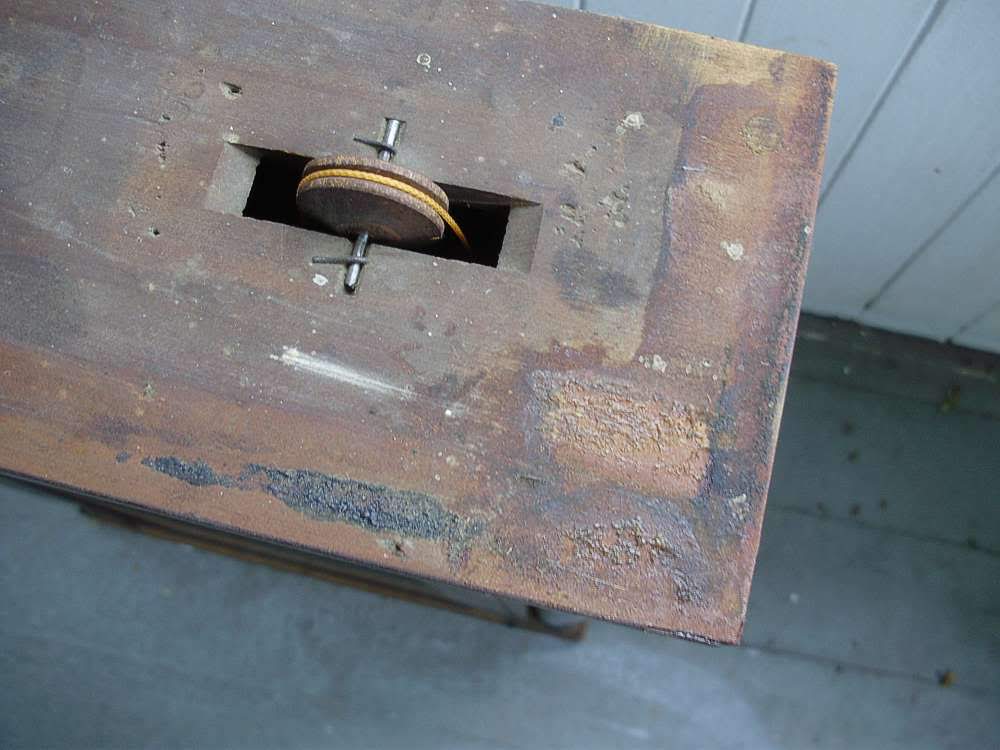
The tops of these clocks generally give you a good idea of what's missing. The missing top elements at the front are clear, but there is also a faint rectangular outline around the pulleys, which suggests that it had rectangular wooden blocks with a trapezoidal side profile. I'll try to make copies of those. Alternatively they may have been tin covers, but usually they have a different shape.


Here, some of the added nails can be seen. There are three clearly visible, with one missing on the large triangular block, and 2 deeply seated in the thin edge of the side return.


The clock largely needs just a few veneer repairs, a new top crest, chimney, and return, and some general servicing/cleaning.

Tuesday, September 5, 2017

11 Clocks Update

Some of you may be wondering what has been going on with the new acquisitions. Well, so far I have done many of the case repairs on the bulk of them, but none are completed yet. Here's a quick summary of what's done and not done on the clocks I've started to restore.

8 Day Sperry Ogee:
- Veneer repairs done
- Case corners reglued
- Dust covers stained and ready to use
- Loose label fragments reglued
- Gong screws antiqued and reinstalled
- Piece of brown paper tape on backboard darkened to match (I didn't want to remove it but I wanted to hide it)
- Additional dial holes and movement mounting block holes patched

Still to do:
- Shellac touch-ups/wax polish
- Find and fit a wood dial (or make and paint one)
- Clean and repair the movement
- Make a minute hand to match the hour hand
- Fit missing parts (weight lines, hooks, weights, bob, etc)
- Painted stenciled glass


8 Day New Haven 2 Door Ogee:
- Veneer repairs to case
- Centre bar rebuilt, veneered, and installed
- Case corners reglued/repaired
- Bottom of case flattened and stained
- Extra dial holes filled
- Pulley repair

Still to do:
- Repair the doors (reglue, square-up, veneer patches, reinstall hinges properly, etc)
- Fit dust covers
- Shellac touch-ups/wax polish
- Find/fit a correct movement, dial, weights, hands, etc
- Painted tablet


Sperry & Shaw 8 Day Column Clock:
- Case repairs
- Veneer repairs

Still to do:
- Shellac touch-ups/wax polish
- Clean and repair movement
- Fit dust covers


E. W. Adams Wooden Works:
- Case repairs (reglue/clamp several pieces)
- Veneer repairs

Still to do:
- Shellac touch-ups/wax polish
- Fit dust covers
- Find/install movement, dial, and parts (this is still largely an empty case)


Jerome & Co. Column & Cornice Clock:
- Veneer repairs

Still to do:
- Shellac finish entire case/wax polish
- Clean and repair movement
- Fit dust covers
- Painted glasses
- Fit hands


C. & L. C. Ives Triple Decker:
- Veneer repairs & case touch-ups
- Cut and fit ivory escutcheon to lower door
- Tint lower door darker
- Cut, veneer, and fit top returns and glue blocks
- Chipped column repair
- Fit hands

Still to do:
- Fit mirror or tablet in centre
- Fit dust covers
- Shellac touch-ups/wax polish
- Clean and repair movement
- Cut, fit, and install rear crest stiffener strips
- Cut and install new (old) dial glass


Wadsworth Pillar & Scroll:
- Patterns cut and prepared (top scroll, base, side returns, etc scaled on the PC from an original)
- Front damaged veneer band pieces removed (wire nails removed) and reglued

Still to do:
A lot. I only just started this one.

Sunday, June 11, 2017

Waterbury Miniature Ogee Clock - Part 1

I have had this clock for long enough that I seem to have lost the paper work for it. I bought it as an empty case. Actually I just checked a purchase list, and I bought it in summer 2006! At the time I wanted a miniature ogee clock, and I believe I may have had a spare Waterbury shelf clock movement for it. I had only paid 34$ USD for the case, plus shipping. Not such a great bargain based on today's prices, but mini ogees back then would normally sell for 200-300$ USD.

Anyhow, the case had lots of loose or flaked-off veneer, and it needed work.

A few years ago (early 2015), while I was working on a whole bunch of different veneering repairs (http://jcclocks.blogspot.ca/2015/02/veneer-patching-extravaganza.html) I had glued down the loose sections of the veneer for this case.


Then a few weeks ago I finished the rest of the repairs. This involved gluing another big section that popped off on the door, and patching the missing sections on the veneer. Before I start showing the patches, this is how the clock looked after the 2015 repairs.


The edge uses curved veneer, so I used some of my pre-curved mahogany veneer stock for the patches. Any of the small chips, I did not use wood, I used putty. This is especially good for small chips along the bottom where the veneer is already really dark.


Putty-filled repairs:


Veneer patch on the corner, putty on the chips.


Again, a mix of veneer and putty. Keep in mind that any putty repairs must be touched-up with paint.


Top left corner:


Top right corner:


All the repairs and patches before stain, paint, and touch-ups.


Stain is applied first. Depending what stains you use, how much sanding you did, and what wood was used, the colour may be too light or too dark. It's kind of difficult to predict how certain spots will turn out. For the painted putty areas, those mainly work best on very dark finishes. This case is quite dark brown, so it's pretty forgiving to mix any "close enough" shade of blackish-brownish-reddish paint, and blend that in. I use one or two small paint brushes, but a lot of it is creative finger painting. Water is used to add transparency.


Bottom chips after painting. There are 4 decent sized chips, and a veneer patch in the left corner.


All the repairs and patches were then coated in several layers of orange shellac. The entire case was then buffed down with #0000 steel wool lubricated in dark paste wax. The wax is left to dry and go dull before polishing.

This shows the wax-buffed case just before polishing (so looking quite dull overall).


Here's just a small bit once you start buffing the wax.


Hopefully I can photograph the finished case soon.

Saturday, June 10, 2017

Antique Mirror Repair

This was a really beautiful antique mirror with beveled glass that I picked up at a Flea Market. I think I paid 10$ for it. The mirror was in perfect shape, but the frame had a few big chips in the curved veneer. I assume that this mirror is from around 1880, but it could be slightly older or newer. Definitely older than 1900.

For probably close to a year it's been patiently sitting and waiting to be repaired. I'm not even sure where I want to hang it yet, but since I've been doing a LOT of veneer patching on clocks lately, I decided to do the repair while I had fresh hide glue on hand.

As purchased:


All 4 corners had chips, but the real issues were with this one bottom corner. The other corners had very tiny chips (I didn't photograph them, they were only about 1/8" wide).

Because of how this corner was broken, I would either need to make two striped patches (which would be tricky and possibly ugly as a repair), or remove the entire corner section, and install a larger patch. This is what I did. With the wood veneer that I removed, I was able to patch all the other 3 corners, so those repairs ended up being virtually invisible.


Corner section removed. The mesh is something new to me. I'm not sure exactly what it was for, but it seems original and I left it there. Part of the veneer was loose past where I cut it, so hide glue was brushed/pushed under there.


The wood was a bit odd. It looks a lot like walnut, but I was fairly sure it was actually mahogany, so I used mahogany for the patch. The wood had to be pre-curved around a form (you just wet the veneer in hot water, clamp it around a curve that is tighter/smaller than what you need, and leave it to fully dry). Once it was glued down (using hide glue and painter's tape as clamps) the edges were trimmed, sanded, and the repairs were stained as needed.


The finish on the mirror was kind of dry and flaky, so I scrubbed down the finish lightly with steel wool and alcohol, and then I added a few thin coats of shellac over the repairs and then over the whole frame. This was then buffed down and wax polished with steel wool (#0000) and dark tinted wax.


The colour match on the patch is not a 100% perfect match because the old veneer was somewhat sun bleached. It blends in fairly well, and it's only a simple mirror, so not a museum piece.


All these techniques can be used to repair clock cases.

Monday, May 22, 2017

8 Day Rosewood New Haven Miniature Ogee - Restoration


The title is a bit of a mouthful, but this is a rather long-to-describe clock. It's a miniature ogee clock made by the New Haven Clock Company, and while most of these tend to be 30 hour duration, this one is an 8 day example. The case is nicely veneered in rosewood, and it's actually an "O.O.G" design, which simply means that it has a concave and convex moulding used for the door and edge band on the case (as opposed to flat).

This is a pretty new purchase (Nov 16 2016), and it's the most recent clock I've purchased. While it looked to be in great shape in the listing photos, there was a bit of damage to it (largely cosmetic), however, it arrived even more damaged. While in transit the movement tore loose, and I was very lucky that neither glass was broken. In addition to this, the door rattled apart, veneer was torn loose, as well as several of the dial blocks. The gong also got slightly mangled, and the dial was slightly warped.

Here are some blurry photos I took just as I was unwrapping the clock.


The movement and dial (as well as all the loose bits of wood and parts) were carefully removed from the case. The dial on this clock is especially lovely. I later gave it a very gentle cleaning to remove some of the dirt.


The door would not close.


Two damaged corners:


Damaged lower right corner.


This spot I could see in the listing photos. It almost looks like a later repair that was done in mahogany rather than rosewood. Some of the banding around the outside edge looks like it could be either wood. I ended up replacing this entire section of veneer.


Top right corner of the door. This is an old repair. I thought of re-repairing it, but ultimately I left it alone and glued it back in place.


The door catch was NOT original, and it was a very poor replacement.


Loose door frame (lower left corner) with a tiny chip.


This was by far the worst of the damage, because it's not something that can be fixed. All these scratches to the backboard were from the movement that had torn free and bounced around. The only way to remove the marks would be to sand or scrape the backboard, and this would ruin the original surface.


Some of the debris.


So now what? Well, it looks rather bad, but it's all fixable. The warped sections of the dial were fixed with gentle finger pressure. The gong was reset fairly easily, and that largely just leaves woodworking problems. A bunch of small pieces were still present (like the broken top left corner of the door), and the rest could be patched.

Here is that wide section of flaky mahogany veneer. I fixed this area with some salvaged rosewood veneer which was already curved. This came from a completely destroyed donor case. For repairs like this, where the clock case is still in good shape, and the original finish is still good, I will do all the repairs and patches without refinishing the case. I simply sand a bit past the new repairs, and then I blend everything in. One of the best parts about antiques finished with shellac is that the new will melt and blend into the old. The only time this doesn't work well is if the existing finish has crackled or alligatored.


Top corner of the door. This was sanded down to level it out a bit better.


Bottom corner of the door. There are sanding marks on a fairly wide spot because part of the edge also broke and had to be glued. That long scratch was also largely buffed and polished out.


Bottom right corner:


All of the screw holes on this clock needed repairs. I decided to plug and patch all the dial holes using pine slivers (not toothpicks) and putty. The top corner block also had a big chunk of wood broken off.


The lower movement mounting block was in pieces. It had broken in 3, but it also had a diagonal break in it, and 2 added nails through it, which I removed.


It had to be clamped in two sessions.


The last things to do were to apply some shellac to the repairs, and then buff the finish and wax polish. Once that was done, I tackled the movement.

The original springs were in terrible shape. Not only were they set (where they don't open up much once they are free/out of the movement), they were also warped and crooked (which isn't good either). I decided to install a new pair of springs. I don't know why, but one of my two new springs opened up about twice as much as the other. I don't replace springs very often, but maybe someone can let me know if this is normal. Both these springs are new, and they are from the same manufacturer, and they were bought at the same time. Tiles are 12" x 12".


All the clock parts after cleaning:


The movement was in fairly good condition, but I did have to dress-up a few pivots on the lathe, and I installed a pair of bushing to the escape wheel.

After re-assembly and during testing:


Here you can see the repaired bottom mounting block. I also had to plug and re-drill all the mounting holes in the backboard.


This is the best photo (out of about a half dozen) that shows the area of the banding that I replaced. I did get a tiny bit of a chip in there, but it matches the overall finish and condition of the clock. I don't remember if I used any stain on this repair. If I did, it was a very light brown, followed by shellac (maybe 5 thin coats?)


Here is the finished clock. It was photographed in late afternoon sun, so the veneer looks a lot lighter and brighter than normal.


I am not familiar with this tablet. I have seen thousands of tablets, and I know a lot of the patterns from memory, but this is not one that I remember seeing. It doesn't seem to have a title, and if it did, that area has flaked away. If anyone has any information about it, or has a photo of another one like it, please let me know.

Note: I was able to find and fit a spare antique door catch, which I had in my spare parts. It is especially well suited to this clock because this door catch is a slightly smaller size than usual.


Here is the clock just slightly ahead of a standard ogee clock (the E.N. Welch which you can see here: http://jcclocks.blogspot.ca/2016/05/e-n-welch-ogee-clock-restoration.html). The standard ogee clock measures 26" x 15.5", and the miniature measures 18 1/8" x 11.5". The dial has a 5" chapter ring.