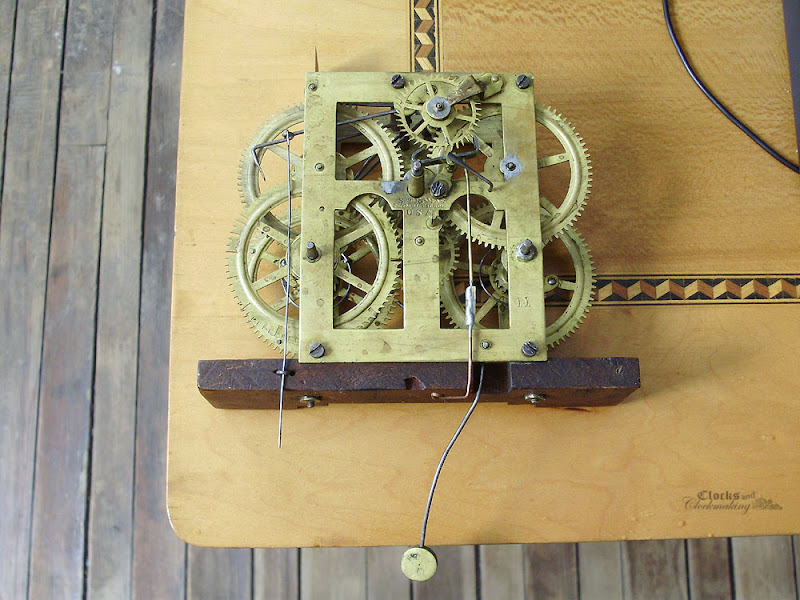
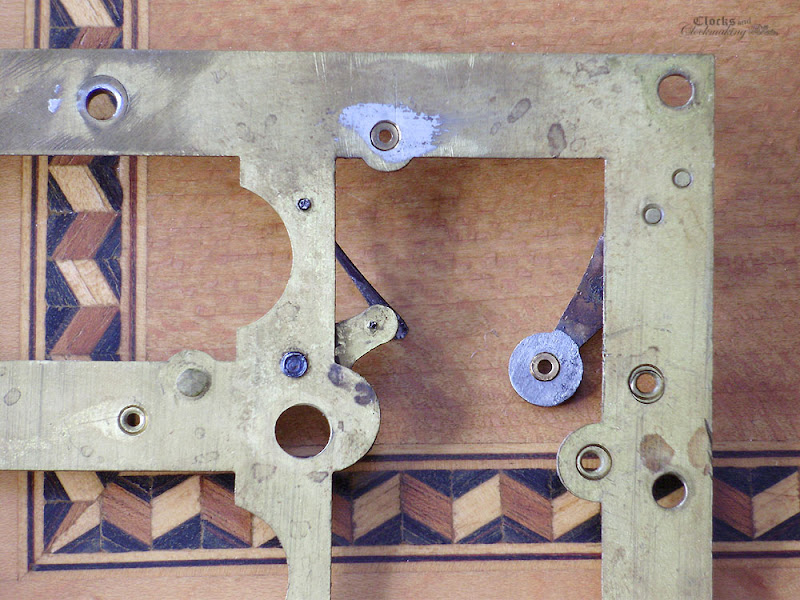
I've already posted the movement restoration from this clock, but lately I've been working on the restoration of the case, which has been on and off for the past year or so. At the current moment I have all of the case completely restored except for the crown moulding, which is always the most complicated part of the case to work on.
Since I'm so close to finishing the restoration on this clock, I want to take the time to post the "before photos" since I haven't done it yet, despite having owned the clock for well over a year (almost 2).
A quick warning: This post will be photo-heavy.
The most nerve wracking part of purchasing a clock like this one (very old, fragile/falling apart, and with lots of easily breakable original painted glasses) is getting it shipped to you. I've dealt with a good number of sellers on eBay, and I've learned that you just don't know how the seller will pack the clock. Even in cases where I made specific requests, often they will just do whatever they want. I've had cases where the clock had the glass protected with a masking tape X, plus a cardboard on each side, 10 layers of bubble wrap, and then double boxed, and on the extreme opposite, I've actually had one ogee clock that was mailed in a completely empty cardboard box. No wadded newspaper, no bubble wrap, no packing peanuts, NOTHING. It somehow survived the trip, but I just could NOT believe it. It's been so long that I'm no longer 100% sure which clock it was, but I'm fairly sure it was the largely empty (but rare) Charles Wilbur clock, which had no dial, no tablet, and an already cracked dial glass. Pictures and info here, if you're curious:
http://www.angelfire.com/me5/clockman/charleswilbur.html
In any case, with this particular clock, most of the value for me was in the original tablets, so I was very nervous about what condition the clock would arrive in. Clocks from this period with both original tablets still intact are starting to be harder and harder to find. One thing that doesn't help matters is that a lot of these larger boxes get kicked around (or crushed) more than smaller parcels during shipping. I also had a previous disaster with the purchase of my first Birge & Fuller Column & Cornice clock (which is a whole other nightmare story of its own that I will save for another time). That clock arrived smashed to pieces, and took me a few years to restore.
Let's just say that when the clock arrived, I was already a bit nervous seeing that the box was slightly crushed...


Luckily for me, the Postal Gods were smiling down upon me that week, and the clock arrived safely in one piece.


I was a bit surprised that the clock did not arrive in slightly worse condition, because there really wasn't a ton of packing to protect it. One or two layers of thin bubble wrap, and a few scrunched-up layers of thin newspaper.
Now here are some of the better photos. I've mentioned it before, but it's worth briefly mentioning again: I've been having problems over the past year with my digital camera (difficulty focusing), and I will need a new one soon. Most of these photos turned out nicely, but several turned out blurry, and I had to sharpen the crap out of them in Photoshop.
One of the first problems you'll note with the case is that the columns are insanely crooked. They also appear to have been glued this way for a long time.

This case has some particularly nice cuts of mahogany veneer.


This centre tablet is truly magnificent. It is painted entirely freehand, and I have not seen another similar one on any other Birge clock of the period (and I've seen close to 100). There are a few scratches to the paint, and a tiny bit of lifting in the centre of a few flowers, but aside from that, the tablet has survived in extremely good condition.

I was lucky enough to secure the purchase of the original dial with the clock. If you will recall from the 2014 post regarding this clock (
here), I purchased it from a rather unscrupulous seller who prefers to make money from these fine clocks by parting them out into multiple separate auctions. The dial was not marked as being the dial for this clock, but rather just as a "wooden works dial". I knew from past research what Birge dials looked like (and what to look for), and I was 95% sure that this was the dial that went with this clock. Clues for me were the size, the dotted minutes, the style of the numerals, and the circular centre opening. The most important detail, however, is the painted corner spandrels. Birge & Fuller had some of the nicest and most finely detailed floral corners, when compared with similar dials of the same period. If I were to be a bit more specific, I'd say that the flowers were usually composed of many more brush strokes/petals and with more detailed leaves than on other dials. The flowers on this specific dial, however, were a bit plainer than I am used to seeing, and they almost had an early "Seth Thomas" style to them (if you've looked closely at a lot of dials you might see what I mean by this). The quality of the dials was the best in the earliest examples (early 1840s) and gradually became plainer and simpler towards the 1850s. In the end I was correct, and the dial is unmistakably original to this clock. I will try to find a salvaged grommet to replace the missing one (none of the new ones offered match the shape or the width).


For comparison (and education), I've assembled this collage of early Birge dials (wooden dials prior to Birge & Peck). You'll note that the last John Birge dial is an exact match, except for the colour difference (light blue as opposed to pink on mine). Another interesting thing to note from this collage is that only ONE dial has the original hands. It is the third dial. All the others are incorrect replacements. The first dial on the list is from my 1845-47 Birge & Fuller Column & Cornice clock. You may also note that the first 4 dials, as well as the 6th one have identical leaf patterns, with only a difference in the style of the flowers. Some dials also feature single rings, or double rings.

Continuing with the case photos, you can see that the crown has been carved and sanded down in some corners during previous "restorations". This will be difficult to repair.


There's a better photo of this detail farther down. Both columns should be touching the inside corners.


The bottom tablet is equally beautiful, but it has a bit more paint loss than the centre tablet. This tablet is a combination of stenciled and freehand decorations. The stenciled portion of the design has a segmented circle, pointed triangles, and two toothed inner circles at the centre (done in silver bronzing powder). The design is then filled-in with shaded paints in blue, cream, and beige. The whole pattern is then decorated with a small freehand lace border, and corner florets. A lot of the backing "frosted" paint is missing, and there are several small scratches overall, but the tablet is in great shape.

This section of the crown moulding was NOT pictured in the listing photos (big surprise).


Another unfortunate bit of damage that wasn't visible in the listing were two broken chunks to the two corners of the columns. The top board is also split in several places.


Evidence of prior repairs to the crown include several wire nails (everywhere), and all sorts of putty filler (including over the screw holes).

Replaced (poorly fitted and poorly shaped) glue block.

One of several inscriptions. This reads: "Cleaned by R. S. Field". It originally took me some effort to decipher because the C and l almost form one fancy letter "C". I originally saw this as "Camd".

Another inscription. This one reads: "E. Erskine, Eldon Iowa, June 1 88" More info on this later.


One of the small drawbacks to this clock is that the label is only partial. Luckily "John Birge & Co" is still clearly visible. What's missing, however, is the Elihu Geer printer's name and address at the very bottom. Elihu Geer was the printer for the Birge labels, but his address on State Street (Hartford CT) changed almost annually, and the address would have been nice to see for research purposes.


I'm not sure what this mark is from, but I wasn't able to remove it with gentle cleaning. It may be a candle burn.

The movement was in terrible condition. It is a Joseph Ives "Roller Pinion" 8 day weight driven movement. All of these Ives movements feature rolling pinions in all the lantern pinions. These usually show nearly no wear after nearly 200 years of use. The wheels also have unusually shaped squared teeth. The "plates" are made up from strips (or straps) of brass which are riveted together. Back then brass was still quite expensive, and this was an easy way to build plates. Clockmakers know these as "strap brass movements". You can see the complete rehabilitation and restoration of the movement in my previous post here:
http://jcclocks.blogspot.ca/2016/01/john-birge-co-movement-restoration.html

The gong was completely mangled. It took a lot of effort to straighten it out again (as much as possible). It doesn't look all that bad in this photo, but it is warped up, down, back up again, and also kinked in several places.

Lovely punch marks around the pivot holes (not repairable), and globs of solder everywhere.


The bottoms on almost all these early clocks tend to be in poor (chipped) shape. This one is no exception.

The end-grain veneers are especially prone to damage (because of the weaker glue bond). There are diagonal cracks through the base, and 2 or 3 cracks in the case side. Also note the missing chunk of wood at the back corner.


Proof that not all of these early clocks had perfect and clear grain/veneer. This clock has a smallish knot on the left side.